 Search

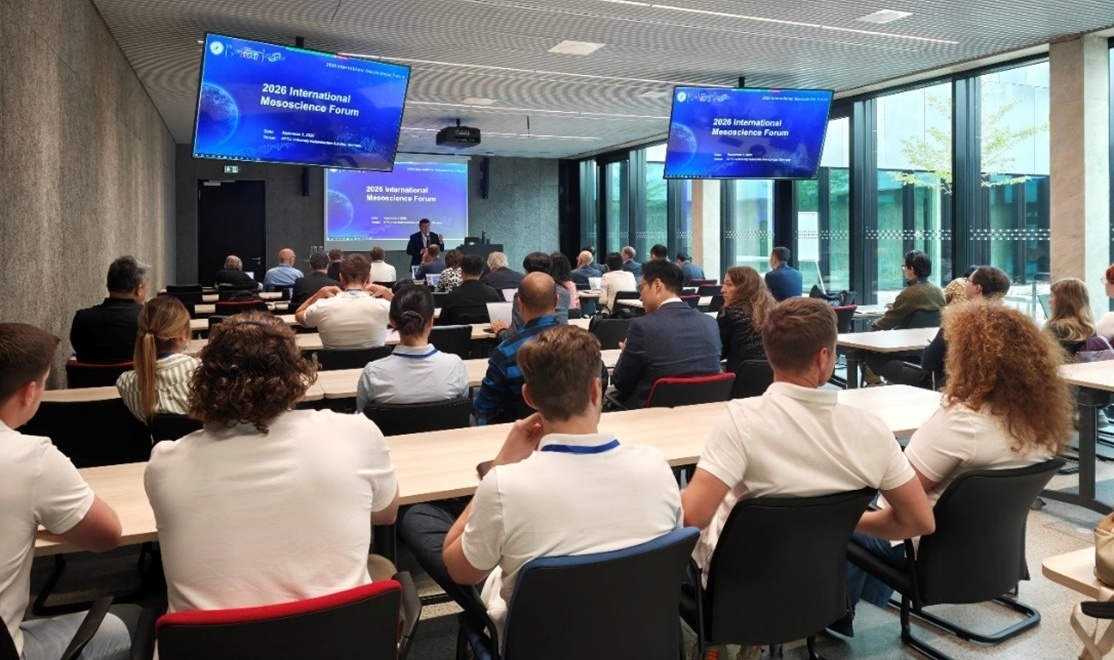
Scientists from China, Germany, the United Kingdom, Australia and other countries gathered at the RPTU University Kaiserslautern-Landau (RPTU), Germany, on September 3-4, 2026, to discuss the transdisciplinary frontiers of mesoscience and their global applications in response to global challenges in sustainable development, climate change and life and health.
The forum, jointly hosted by the International Panel of Mesoscience (IPM), the Institute of Particle Process Engineering (MVT) of RPTU University Kaiserslautern-Landau, and the State Key Laboratory of Mesoscience and Process Engineering of China (MESO), served as an overseas flagship event of the 2026 World Science and Technology Development Forum, drawing over 50 experts, scholars and industry representatives.

Themed "Transdisciplinary Frontiers of Mesoscience and its Global Applications," the forum covered four selected application fields—sustainable development, biomedicine, materials science and artificial intelligence—featuring a grand opening, keynote speeches, poster presentations, breakout discussions and a workshop. The forum aims to strengthen cross-border transdisciplinary research-industry cooperation, accelerate advances in mesoscience and its technological integration, and yield actionable research outcomes that address urgent multiscale challenges.
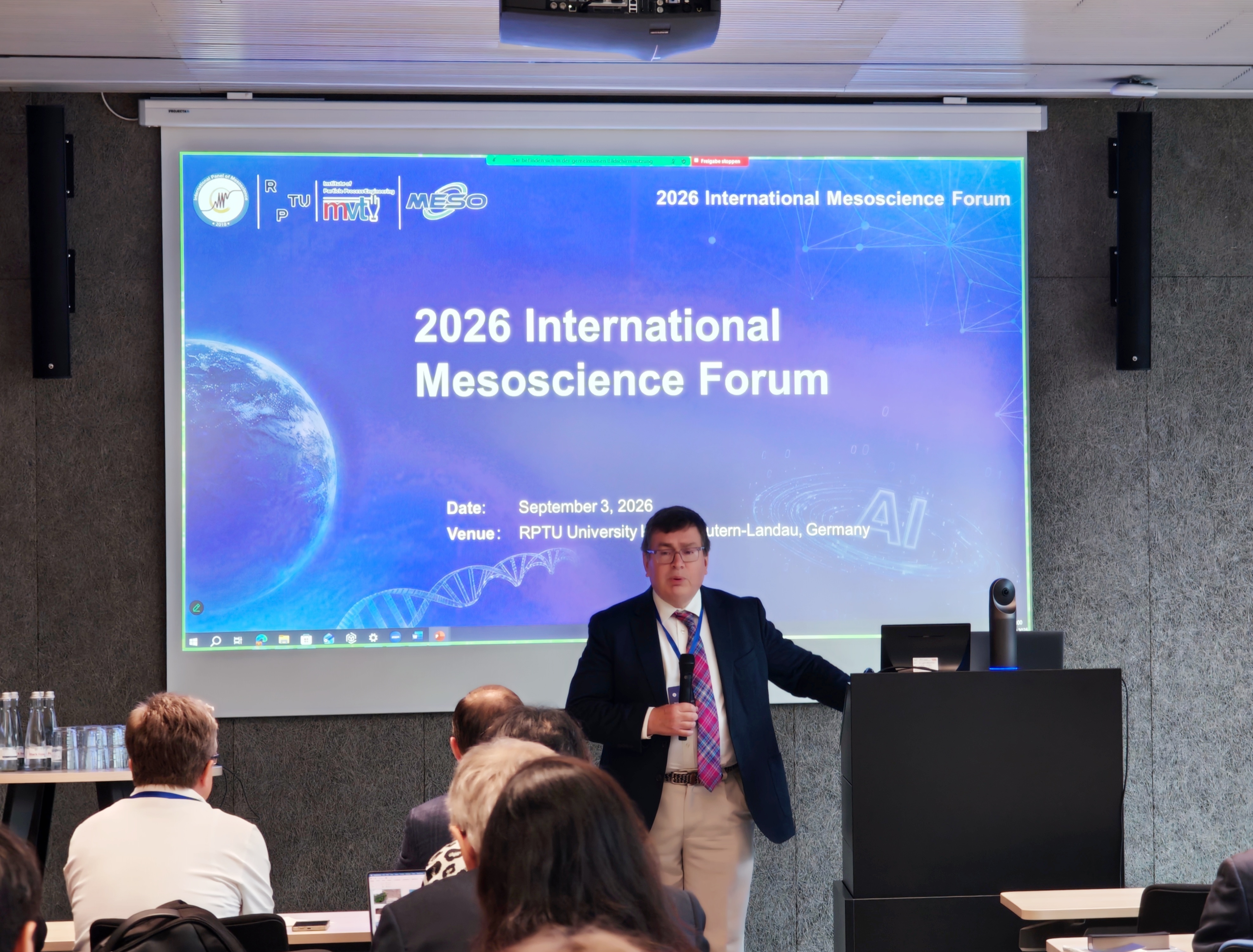
"Everything we learn in the world that we try to account for is really a particle level, be it the quantum scale right through to a human body scale. And we today are in the business of describing systems of systems," said Prof. Richard Williams, Principal and Vice-Chancellor of Heriot-Watt University and Vice President of IPM, who chaired the opening session. "As practitioners of mesoscience, we are throwing away the black-box models and we are using descriptors that try to understand what's going on in the real process."

In his address, LI Jinghai, Member of the Chinese Academy of Sciences and President of IPM, noted that mesoscience offers a new perspective for describing in detail complex multiscale systems, and that the forum brings together engineers, mathematicians, biologists and computer scientists, united by a shared curiosity about mesoscience, to explore both the science and its applications through open dialogue.
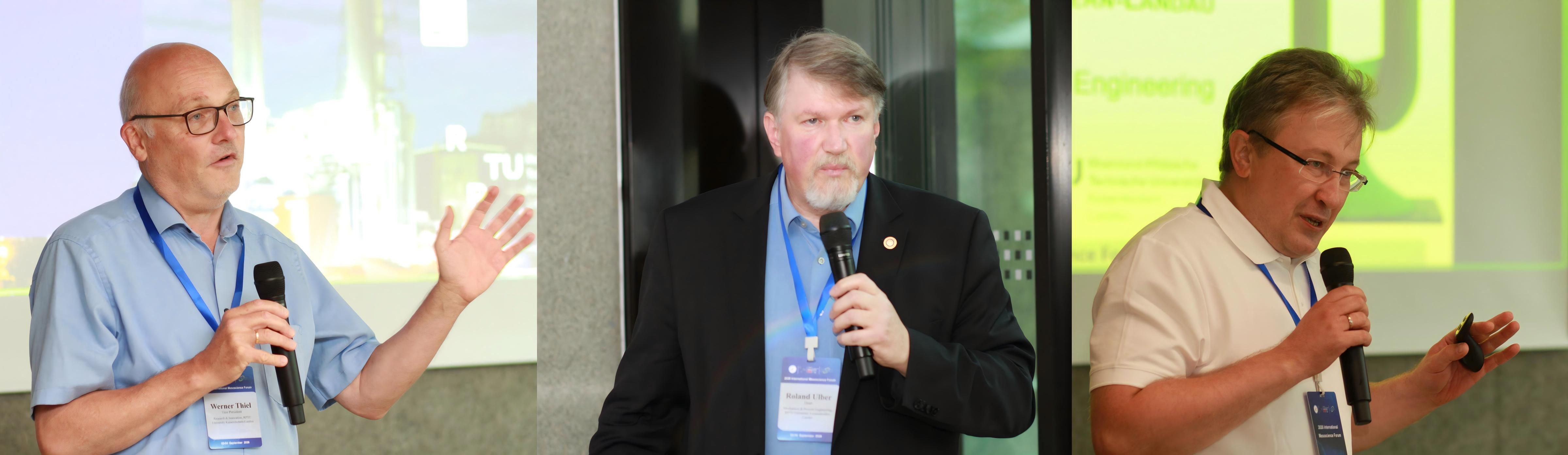
Prof. Werner Thiel, Vice President for Research and Innovation of RPTU, introduced the host university and its strengths in engineering, natural sciences, 5G/6G and artificial intelligence, while Prof. Roland Ulber, Dean of Mechanical and Process Engineering, and Prof. Sergiy Antonyuk, Head of the Institute of Particle Process Engineering, welcomed participants and presented their institutes' research in particle mechanics, multiscale modeling and particle measurement technologies.
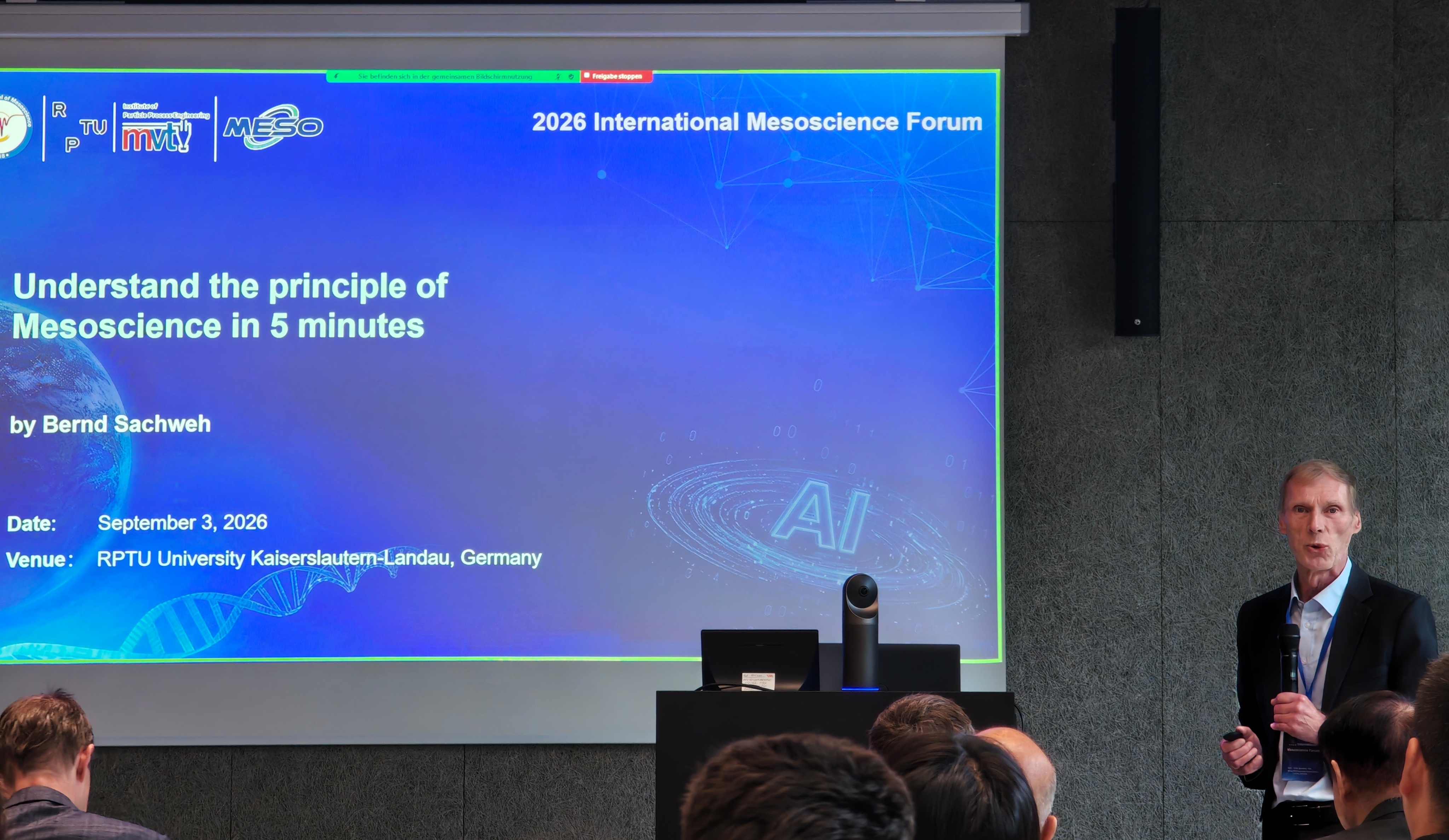
In a five-minute keynote, Prof. Bernd Sachweh, Vice President of IPM, introduced the principles of mesoscience. "Mesoscience is a transdisciplinary scientific field that explores common principles governing complex systems at a meso state, the middle level between microscopic and macroscopic states," he said. Using the choice of routes from Kaiserslautern to New York as an analogy, he explained that additional constraints derived from time, length and mechanism can be applied to governing equations to obtain more detailed information. "The principle is simple, but it's very difficult and challenging to implement and to find the right transitions," he noted.

The session on Sustainable Development Goals (SDGs), chaired by Prof. Raffaella Ocone, Fellow of the Royal Academy of Engineering and Deputy Secretary-General of IPM, featured ZHANG Junze from the Research Center for Eco-Environmental Sciences of CAS, who presented the "competition and compromise" principle as a shared scientific principle for supporting SDG achievement and post-2030 governance, together with a scale-dependent classification of SDG targets.
In the biomedical session chaired by Prof. Sergiy Antonyuk, LI Juan of the Ningbo Institute of Materials Technology and Engineering of CAS introduced the concept of boundaries in biomedicine and neuropeptide-based probes that can cross physiological bahhiers such as the blood-brain bahhier for disease identification and modulation, while Christina Surulescu of RPTU presented a multiscale mathematical model of meniscus tissue regeneration in an artificial scaffold, bridging receptor binding dynamics at the microscale and population-level behavior at the macroscale.
The materials session, chaired by Prof. Bernd Sachweh, featured "When Stability is Not an Option: Living in the Mesoregime" by Antoinette Tordesillas of the University of Melbourne and Deputy Secretary-General of IPM. Drawing on a mountain community in Nepal affected by earthquake-triggered landslides, she showed how mesoscience-informed monitoring of ground motion can delineate high-risk regions and inform how communities can coexist with persistent hazards. "People continually change the mountain. The mountain continually changes people's lives, and both respond to a changing and increasingly hazardous environment. So stability is not an option", she said. Carsten Schilde of Technical University of Braunschweig then traced the evolution of modeling in particle technology from mechanistic equations to coupled discrete element method (DEM) simulations and AI-based workflows, stressing that progress requires combining experiments, simulations and AI methods.
The AI session, chaired by Prof. YANG Ning, Secretary-General of IPM, Director of the SKLMPE featured Sebastian Vollmer of the German Research Center for Artificial Intelligence (DFKI) on generative dynamics for physical systems, and SHAO Yilei, Founding Dean of the Shanghai AI-Finance School at East China Normal University, who argued that intelligence should be understood as a process. "If you think of intelligence and discovery as a process, the question is: what is the reactor that produces intelligence?" she asked, identifying the mesoscale of AI—how representations of concepts and their relations give rise to capabilities—as the key missing layer.
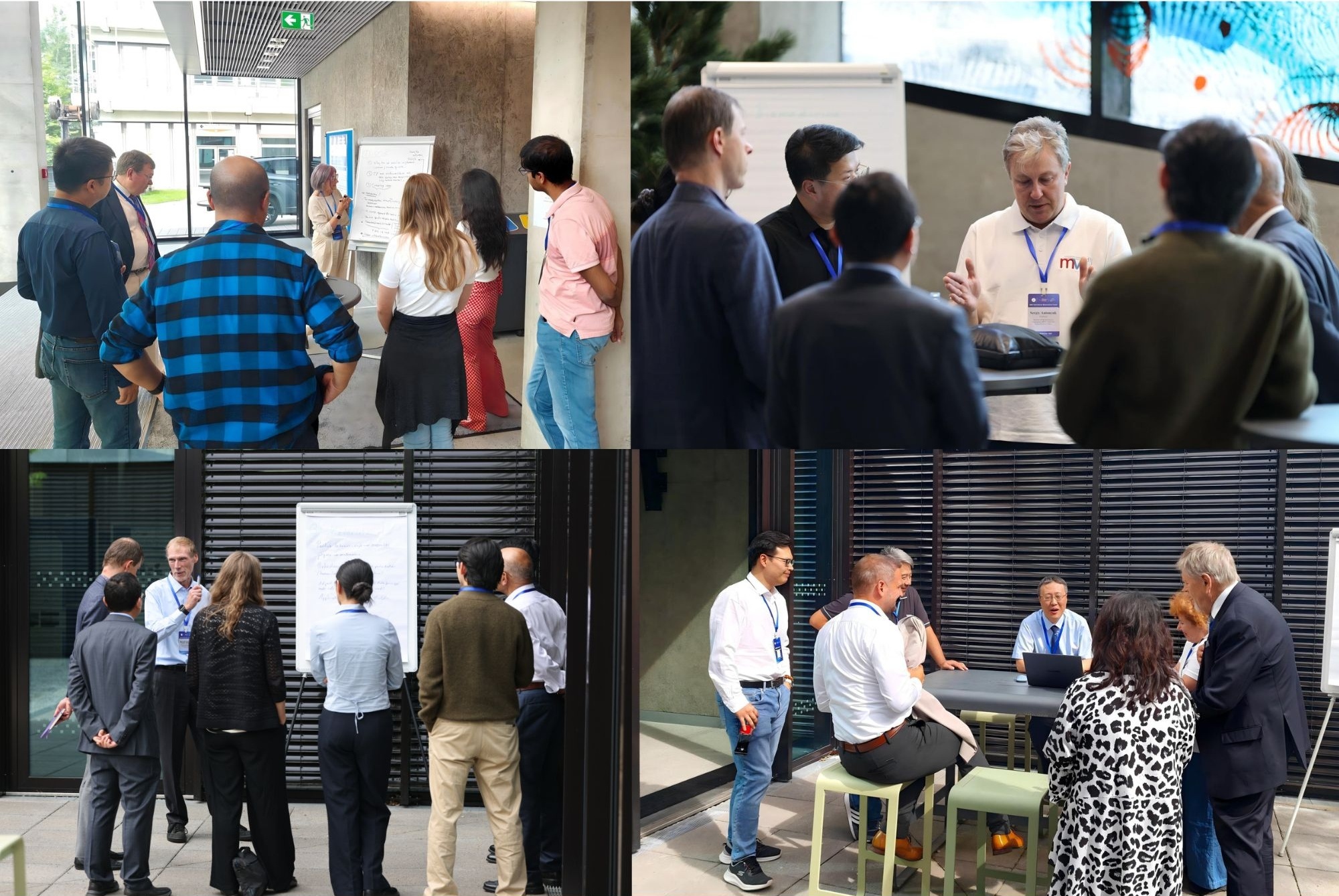
The forum also featured a workshop themed "Mesoscience Meets Applications," provided a platform for in-depth exchange on feasible pathways for addressing major global challenges.
Prof. Raffaella Ocone delivered a summary report on integrating mesoscience principles into domain-specific innovation. She highlighted climate modelling, energy transition and policy governance as areas where mesoscience can contribute to innovation, and called for a community of practice and a unified voice to engage policymakers.
Initiated in 2018, IPM is committed to advancing mesoscience worldwide. The forum served as a platform for academic exchange and industry-university-research collaboration in mesoscience, promoting international interdisciplinary cooperation and the integration of fundamental research with applications.


 京公网安备110402500047号