 Search


Division of Mesoscience is devoted to solving the common challenges at the frontiers of process engineering, establishing the multi-scale theories, and developing efficient and accurate simulation and experimental methods for various complex systems. The studied complex systems include gas-solid and gas-liquid flow systems, turbulence, granular flow, material and biochemical engineering, etc.
In 2025, the division conducted more than 90 research projects, including major projects funded by the National Natural Science Foundation of China and strategic priority science and technology programs of the Chinese Academy of Sciences, as well as industrial collaborations with multiple enterprises. The division published over 80 papers in leading journals in chemical engineering and related fields, filed applications for 13 invention patents and registered 16 computer software copyrights. International Panel of Mesoscience (IPM) operates normally and hosted the Third East Lake·Mesoscience Forum. Both the Mesoscience and Virtual Process Engineering platforms at Huairou Science City have passed technical acceptance inspections.
Breakthrough 1: Mesoscience case studies
In the field of AI, it was proposed that datasets, AI models, modeling software, and hardware architectures should follow consistent logical structures (Engineering 2025, 47: 14; Engineering 2025, 50: 13). This novel AI logical framework was evaluated by international media as "the philosophical manifesto of AI 2.0, a quieter revolution" (https://gazeon.site/ai-needs-a-smarter-blueprint-say-complexity-scientists/). Meanwhile, an optimization method of dominance regulatory between memorizing and forgetting based on mesoscience principles was proposed (Machine Learning: Engineering, 2025, 1: 015003). In immunology research, three characteristic regimes and two critical transition points have been elucidated, establishing intrinsic connections between mesoscience and immunological studies (Cancer Innovation, 2025, 4: e70030). Regarding liquid structures, it has been demonstrated that gaseous and solid states are independent thermodynamic phases governed by single dominant mechanisms, whereas liquid represents a hybrid thermodynamic state where characteristics alternate between gas-like and solid-like dominance (Chemical Physics, 2025, 595: 112725). For three-phase flow simulations involving gas-liquid-solid interactions, a mesoscale model incorporating bubble-induced turbulence and particle-induced turbulence has been developed, significantly enhancing prediction accuracy of turbulent kinetic energy (Chemical Engineering Science, 2026, 323: 123213).
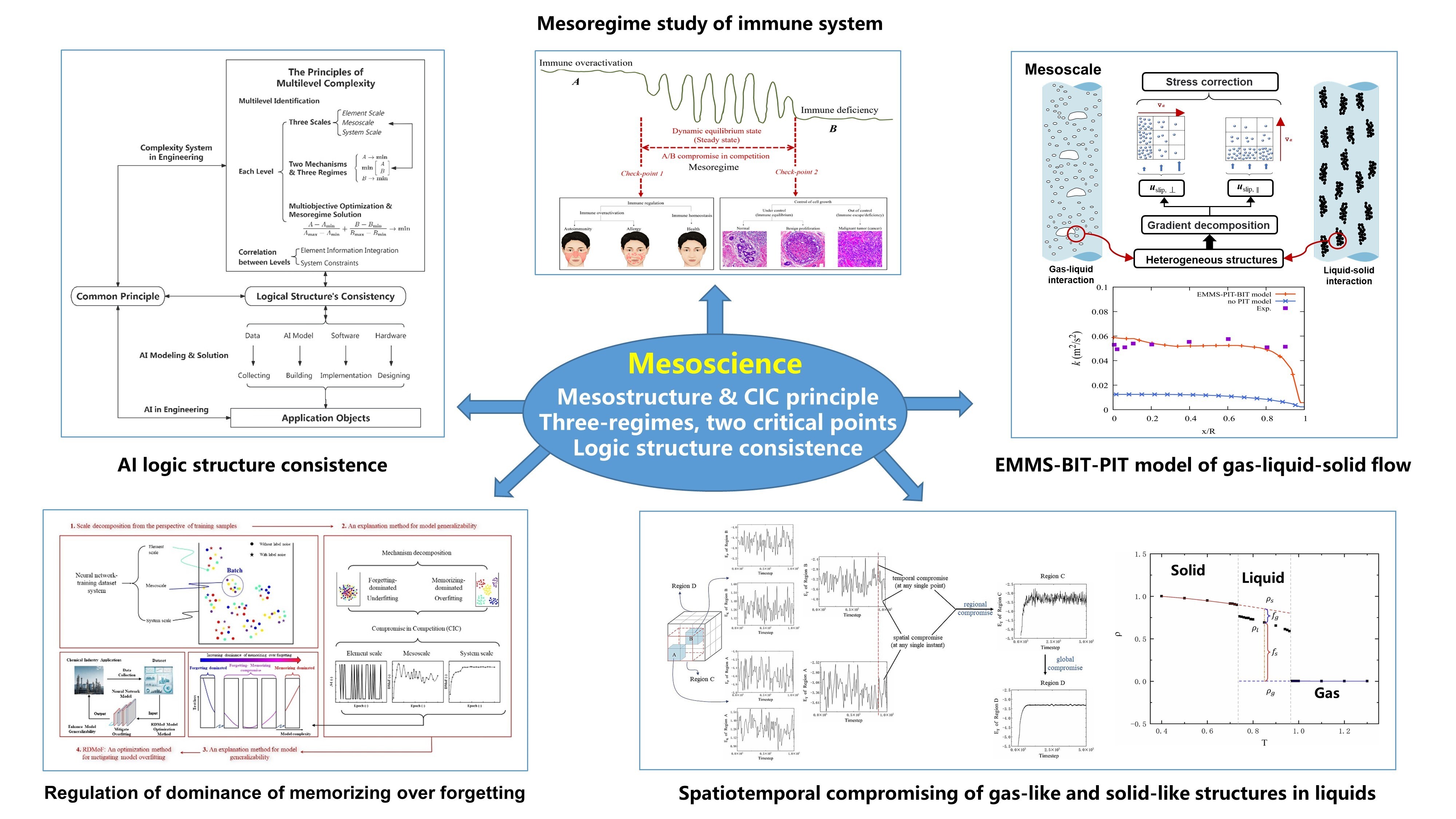
Fig.1 Mesoscience case studies
Breakthrough 2: High-fidelity simulation of an industrial-scale catalytic cracking "reaction-regeneration" full loop circulation system
To address the challenges of coupled multiple operational units prediction and empirical regulation in industrial-scale reactive equipment, a computational model encompassing all core units—including the pre-lift zone, feed injection zone, primary/secondary reaction zones, cyclones, disengagement zone, coke combustor, regeneration zone, and particle transport system—was established. This work pioneered high-fidelity simulation of the catalytic cracking “reaction-regeneration” full loop under conditions closely approximating actual industrial operations. The complex interactions among operational units in practical chemical reaction systems were accurately reproduced, enabling precise prediction of catalyst coke deposition dynamics throughout the entire transport process. These findings provide foundational data and design principles for developing next-generation process control software, achieving intelligent optimization of equipment operation, and realizing energy conservation with carbon emission reduction. The related achievements have been published in AIChE Journal (2025, 71: e18845) and Engineering (DOI: https://doi.org/10.1016/j.eng.2025.02.024), with recognition as highlighted research by Advances in Engineering.
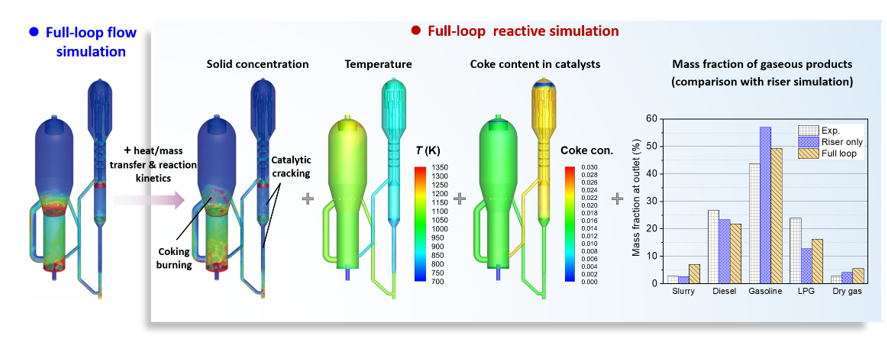
Fig.2 Reactive simulation of the full-loop industrial fluid catalytic cracking (FCC) “reaction-regeneration” unit
Breakthrough 3: Achievement transformation of multi-scale discrete simulation software DEMms
The multi-scale discrete element simulation software DEMms with full independent intellectual property rights has been successfully developed. Based on the original mesoscience theory, this software has overcome key technical bottlenecks including coarse-graining of complex particle systems, large-scale heterogeneous parallel computing, and coupling of multiple processes in reaction and transfer phenomena. It possesses the capability to simulate complex multiphase flow processes, significantly enhancing design optimization efficiency for industrial equipment and processes. Testing results demonstrate that DEMms achieves world-leading computational performance, with particle computation scale exceeding international benchmark software by two orders of magnitude, computational speed faster by one order of magnitude, and more accurate force calculations. These advancements effectively address the challenges of computational capacity and precision in large-scale industrial simulations. The current achievements have validated their excellent applicability in fields such as chemical engineering, metallurgy, and pharmaceuticals, completed technology transformation, and officially entered the commercial development and promotion phase, which is expected to break the monopoly of foreign software in this field.
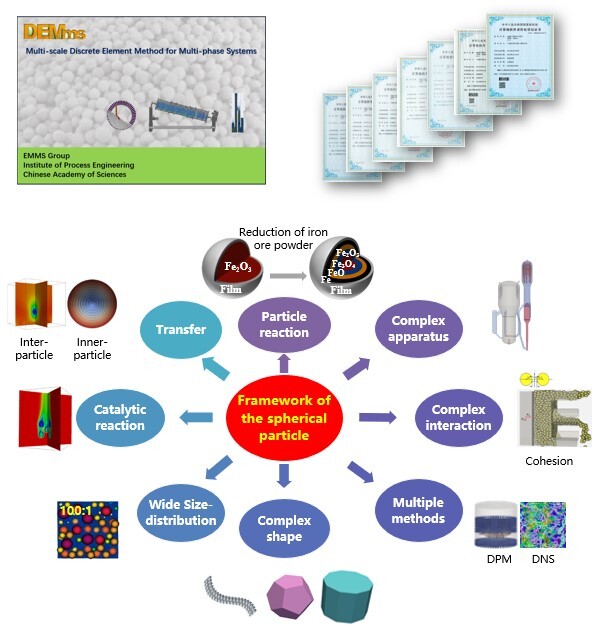
Fig.3 Multi-scale discrete simulation software DEMms
Breakthrough 4: Design optimization and development of new water electrolysis hydrogen production equipment
The filter-press electrolyzer is a core component in large-scale alkaline water electrolysis for hydrogen production, but it faces challenges such as bubble accumulation that affect electrolysis efficiency. Our team has achieved two key breakthroughs in optimizing the performance of filter-press electrolyzers, focusing on flow channel design simulation and innovative process development. To address bottlenecks such as uneven flow fields and significant dead zones in traditional devices, we innovatively proposed an optimization strategy for the concave-convex units of the polar plates, characterized by elements densely packed at the center and sparsely distributed at the periphery. Through numerical simulations and experimental validation, we successfully developed a novel gradient-distributed mastoid-plate structure, which enhanced flow field uniformity by 27% and reduced flow dead zones by 10 percentage points, significantly improving heat and mass transfer as well as bubble detachment efficiency (Chemical Engineering Journal, 2025, 515: 163908. CIESC Journal, 2025, 76: 584). Additionally, we developed granular electrode alkaline water electrolysis technology, optimizing the electrolysis system based on the principle of liquid-solid fluidization. Simulation analysis confirmed more uniform alkali solution flow distribution within the electrolyzer, along with simplified scalability and excellent electrolysis performance. These achievements, validated through multiphysics coupling simulations and pilot-scale testing, provide critical technological support for reducing costs and improving efficiency in water electrolysis for hydrogen production.
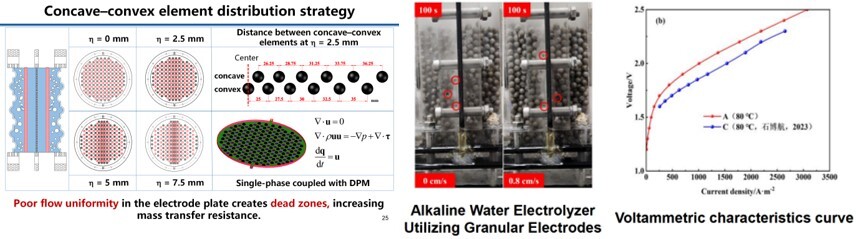
Fig. 4 Design optimization and development of new water electrolysis hydrogen production equipment



 京公网安备110402500047号