 Search

A research team led by Prof. WAN Yinhua from the Institute of Process Engineering (IPE) of the Chinese Academy of Sciences has developed a machine learning (ML) framework to analysis virus filtration processes in therapeutic protein purification. The new method enables intelligent identification of critical parameters affecting virus retention efficiency and provides predictive guidance for process optimization.
The findings were published in Journal of Membrane Science (DOI: 10.1016/j.memsci.2025.124266)
Virus filtration is a key step in ensuring the safety of biopharmaceuticals, but the process is complicated by the interplay of membrane properties, operational settings, and solution environments. Conventional approaches struggle to capture nonlinear relationships and synergistic effects among factors like membrane type, flux, protein concentration, and volumetric throughput, limiting efficient process development.
To address these challenges, the researchers collected over 900 datasets form peer-reviewed publications to construct a database for virus clearance processes to train ML models and analyze the complex coupling effects of key parameters, establishing a data-driven approach for the efficient development of virus removal processes.
The feature importance assessment prioritized key virus filtration parameters, providing guidance for process optimization. Univariate Partial Dependence Plot (PDP) analysis revealed the independent influence of each variable on virus retention, while bivariate PDP analysis showed increased flux mitigates negative variable interaction effects on log reduction value (LRV), offering data-driven mechanistic insights.
Validation experiments confirmed strong agreement between model-predicted and experimentally measured LRV values, with the model maintaining accuracy beyond the original dataset scope, demonstrating robust extrapolation capability and significant engineering value.
"Our framework reduces reliance on trial-and-error experimentation, enabling a rapid process prediction. It also addresses the standardization of data protocols essential for integrated process intensification," said Prof. FAN Rong, corresponding author of the study.
This study establishes a data-driven optimization paradigm for virus filtration, offering a scalable ML solution to intelligently intensify downstream biopharmaceutical purification.
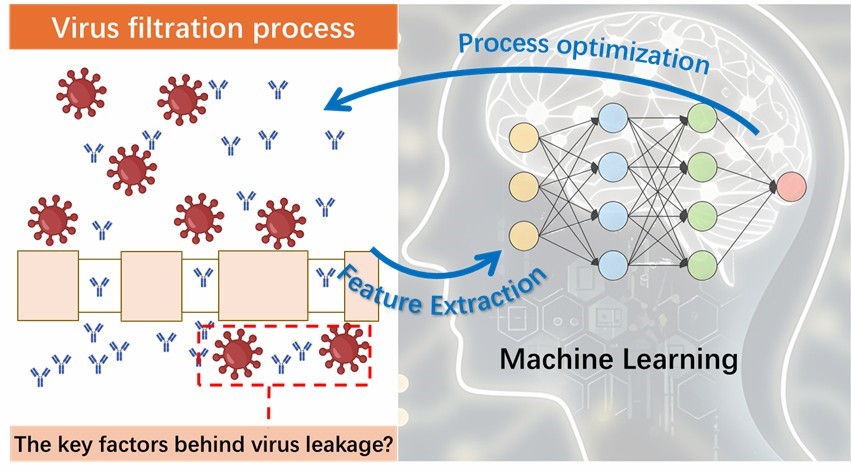
Schematic of machine learning-assisted process analysis and performance prediction (Image by SU Xinwei)
Media Contact:
LI Xiangyu
Public Information Officer
Institute of Process Engineering, Chinese Academy of Sciences, Beijing 100190, P. R. China.
E-mail: xiangyuli@ipe.ac.cn
Tel: 86-10-82544826



 京公网安备110402500047号