 Search

Chimeric antigen receptor T (CAR T) cell therapy represents a milestone in leukemia treatment. CAR T works by genetically engineering a chimeric antigen receptor on the surface of the patient’s T cells to target specific antigens on leukemia cells, with the goal of identifying and eliminating them.
However, clinical data show that more than 50% of patients eventually relapse after CAR T treatment. One major reason is that leukemia cells can reduce or lose expression of the targeted antigen under therapeutic pressure. When this occurs, CAR T cells can no longer effectively recognize and eliminate leukemia cells.
Previous efforts to address this limitation have relied heavily on redesigning CAR structures through additional genetic engineering, a process that is time-consuming, costly, and technically complex.
Now, researchers from the Institute of Process Engineering (IPE) of the Chinese Academy of Sciences have developed a biomimetic platform that significantly enhances CAR T cell therapy for relapsed and refractory leukemia without requiring any genetic modification of CAR T cells.

A Biomimetic Platform to Enhance CAR T Cell Therapy Against Leukemia (Image by LI Feng)
The strategy, validated in vivo in multiple relapsed and refractory leukemia mouse models, as well as in vitro using a large number of patient-derived samples, was reported in Cell on March 9. (DOI:10.1016/j.cell.2026.02.005)
The researchers collaborated with Zhujiang Hospital and the Institute of Hematology & Blood Diseases Hospital to analyze a large number of clinical samples. Their analysis revealed that CD71—a protein involved in transporting iron into cells—is highly expressed on leukemia cells across different leukemia types and disease stages, as well as on autologous CAR T cells.
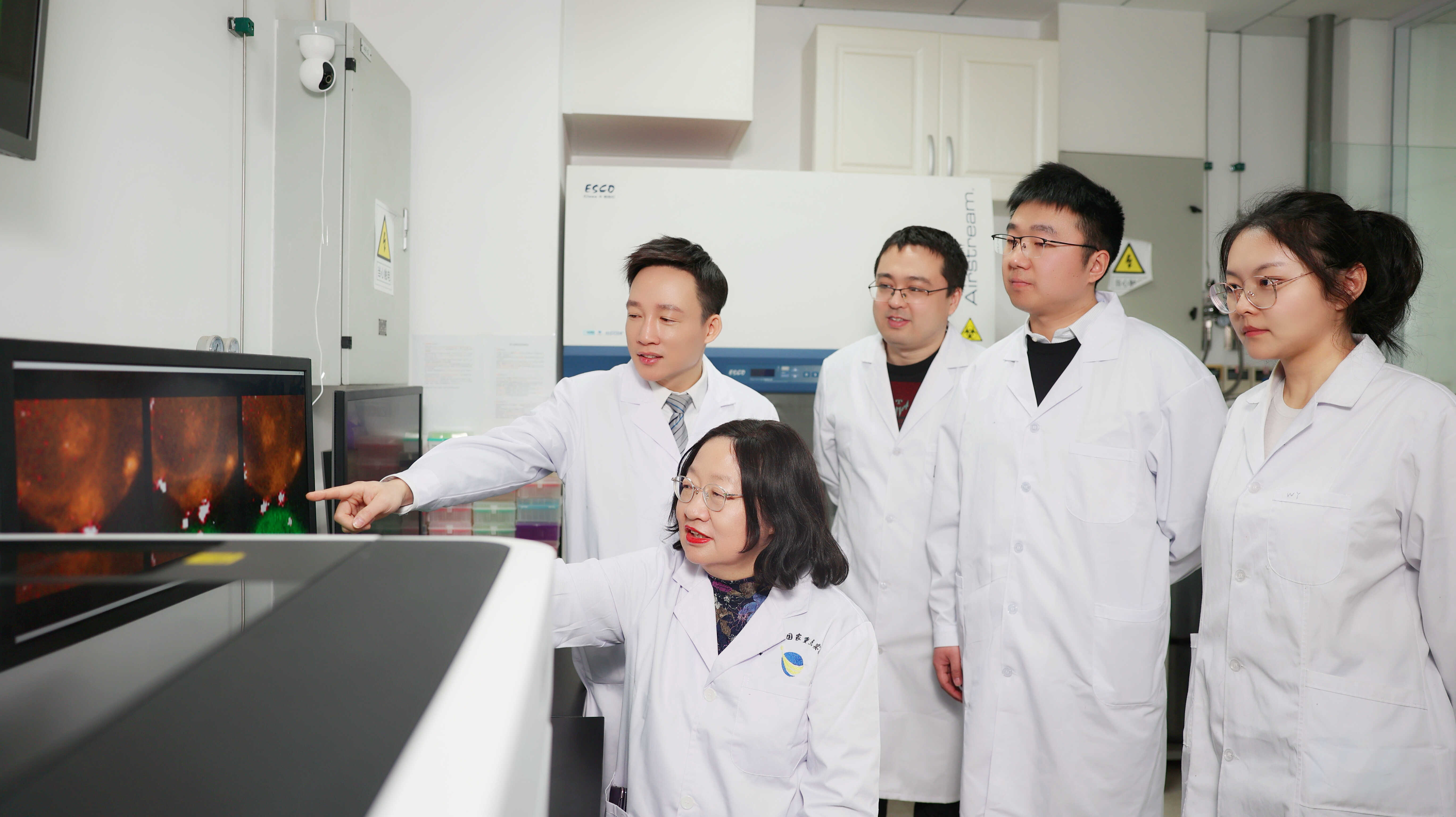
Research Team (Image by FU Zhuowang)
Based on this finding, the researchers precisely controlled the solvent environment and assembly conditions to induce the ordered self-assembly of ferritin, the natural ligand of CD71, thereby creating a biomimetic ferritin aggregation cell engager (FACE)—a molecular “bridge” that reinforces the interface between CAR T cells and leukemia cells.
During CAR T cell preparation, FACE binds firmly to CD71 on the surface of CAR T cells. After infusion, the FACE on CAR T cells also attaches to CD71 on leukemia cells. By linking the two cell types, FACE strengthens their interaction and enhances CAR T cell recognition and elimination of leukemia cells.
In leukemia patient-derived xenograft (PDX) models with normal antigen expression, FACE-CAR T cells achieved the same therapeutic effect as conventional CAR T cells using only one-fifth of the cell dose, while significantly reducing the risk of cytokine release syndrome.
Even when leukemia antigen levels dropped below 10% of normal—a condition under which conventional CAR T cells were largely ineffective—FACE-CAR T cells were still able to effectively eliminate leukemia cells, achieving 100% survival in PDX models.
The researchers further developed a drug-loaded FACE, termed FACED, by utilizing ferritin’s cage-like structure. FACED-CAR T cells effectively treated PDX models with an initial leukemia burden of up to 40% and low antigen expression. FACED-CAR T cells also eliminated antigen-negative leukemia cells, which are often responsible for relapse.
“Our FACE platform is composed of an endogenous protein and FDA-approved polymer derivatives and can be prepared through a simple and scalable process,” said Prof. WEI Wei, corresponding author of the study from IPE. “Importantly, it can be seamlessly integrated into existing CAR T cell manufacturing workflows as a culture supplement that is co-incubated with CAR T cells prior to infusion, without any additional genetic engineering of CARs.”
“By systematically evaluating FACE across diverse patient-derived leukemia samples and clinically relevant PDX models, we demonstrated its broad applicability across disease subtypes and treatment-resistant settings,” said Prof. MA Guanghui from IPE. The researchers also established an efficacy database and developed an AI-assisted predictive framework capable of accurately forecasting FACE-mediated enhancement.
Peer reviewers at Cell described the findings as “highly relevant to the CAR T field” and a “promising translational approach” to improving responsiveness against hematologic malignancies. They emphasized that the strategy’s lack of additional genetic engineering could be implemented in a wide variety of clinical settings and highlighted its potential to counteract the heterogeneity of leukemia antigens.
In summary, this study presents a biomimetic platform that enhances CAR T cell performance through improved cell engagement and targeted drug delivery. Supported by strong preclinical validation, the strategy offers a practical approach to improving outcomes in relapsed and refractory leukemia.
Media Contact:
LI Xiangyu
Public Information Officer
Institute of Process Engineering, Chinese Academy of Sciences, Beijing 100190, P. R. China.
E-mail: xiangyuli@ipe.ac.cn
Tel: 86-10-82544826



 京公网安备110402500047号